Neck, shoulder, back and leg pain: don't keep writing it off as "just being tired"
The same neck pain can have a completely different root cause. Brushing it off with "just being tired" often lets a small problem become a big one. How Chinese medicine understands pain, how it treats it, and how to protect yourself day to day.
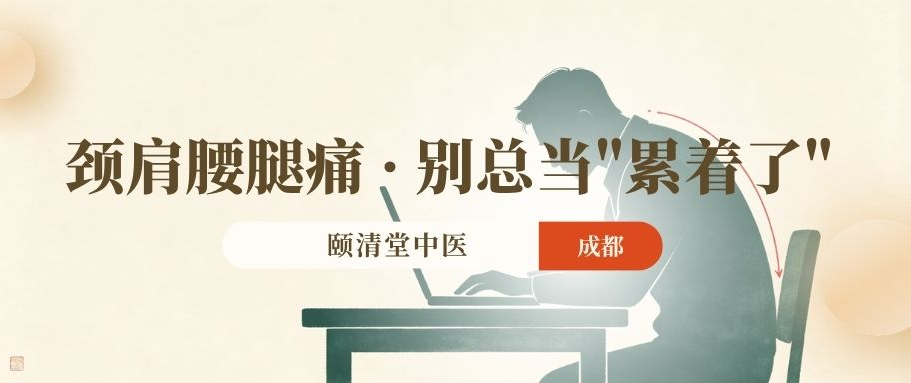
In our clinic, the largest group of patients comes for neck, shoulder, back and leg pain. Ask them, and nine out of ten say, "I'm probably just tired — I'll be fine after a rest." But many people rest and rest again, and the pain is still there, sometimes worse than before.
Neck, shoulder, back and leg pain is one of the most common signals the body sends. Understanding it is better than pushing through it.
First, know this "human crane"
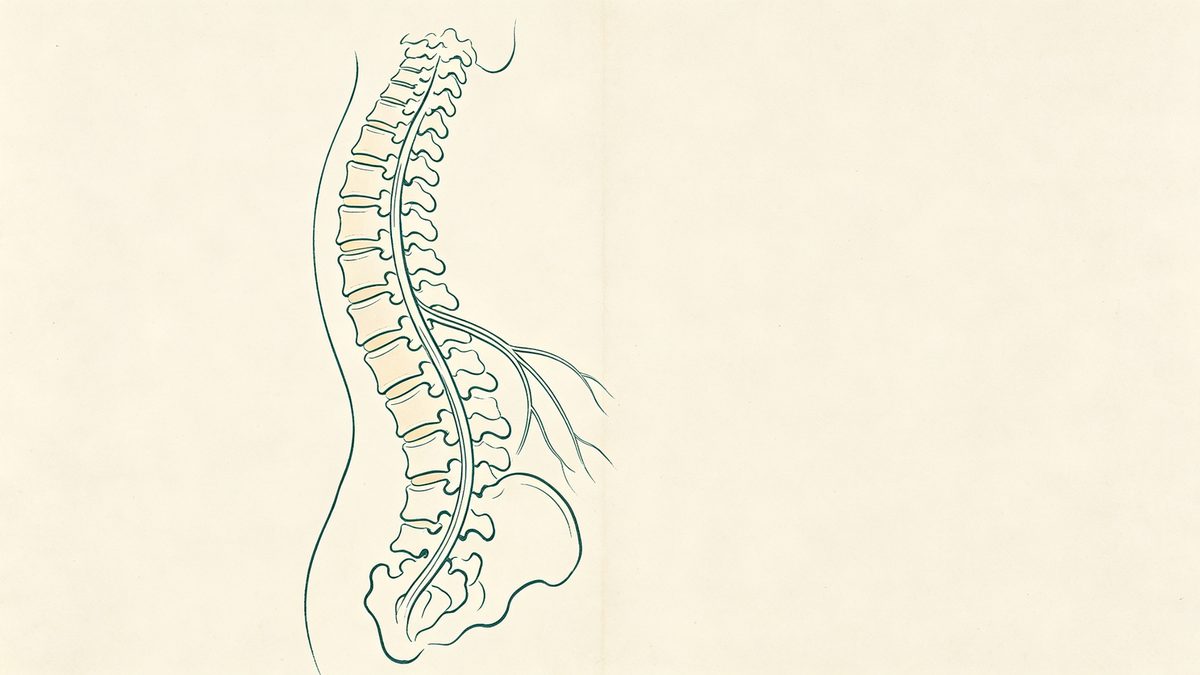
The human spine, from the neck down to the lower back, is made up of more than twenty vertebrae stacked one upon another, with intervertebral discs between them acting as spring cushions. Inside the vertebral column lie the spinal cord and the nerves, which emerge between the vertebrae and govern sensation and movement throughout the body.
This structure is sturdy, genuinely sturdy — it can hold up the whole body. It is also delicate, genuinely delicate, and what it tolerates worst is staying in one position for too long.
Why the words "just being tired" do the most harm
"Tired" is far too vague a word, and it covers up the real problem. The same neck pain may come from muscle strain, from a minor misalignment of the cervical facet joints, or from a disc pressing on a nerve. The same lower back pain may come from lumbar muscle strain, from a herniated lumbar disc, or from a problem elsewhere that refers pain to the back.
Different root causes call for treatments that are worlds apart. Smooth things over with "just being tired," and in the end a small problem is dragged out until it becomes a big one.
How Chinese medicine sees it: where there is obstruction, there is pain; where there is insufficient nourishment, there is also pain
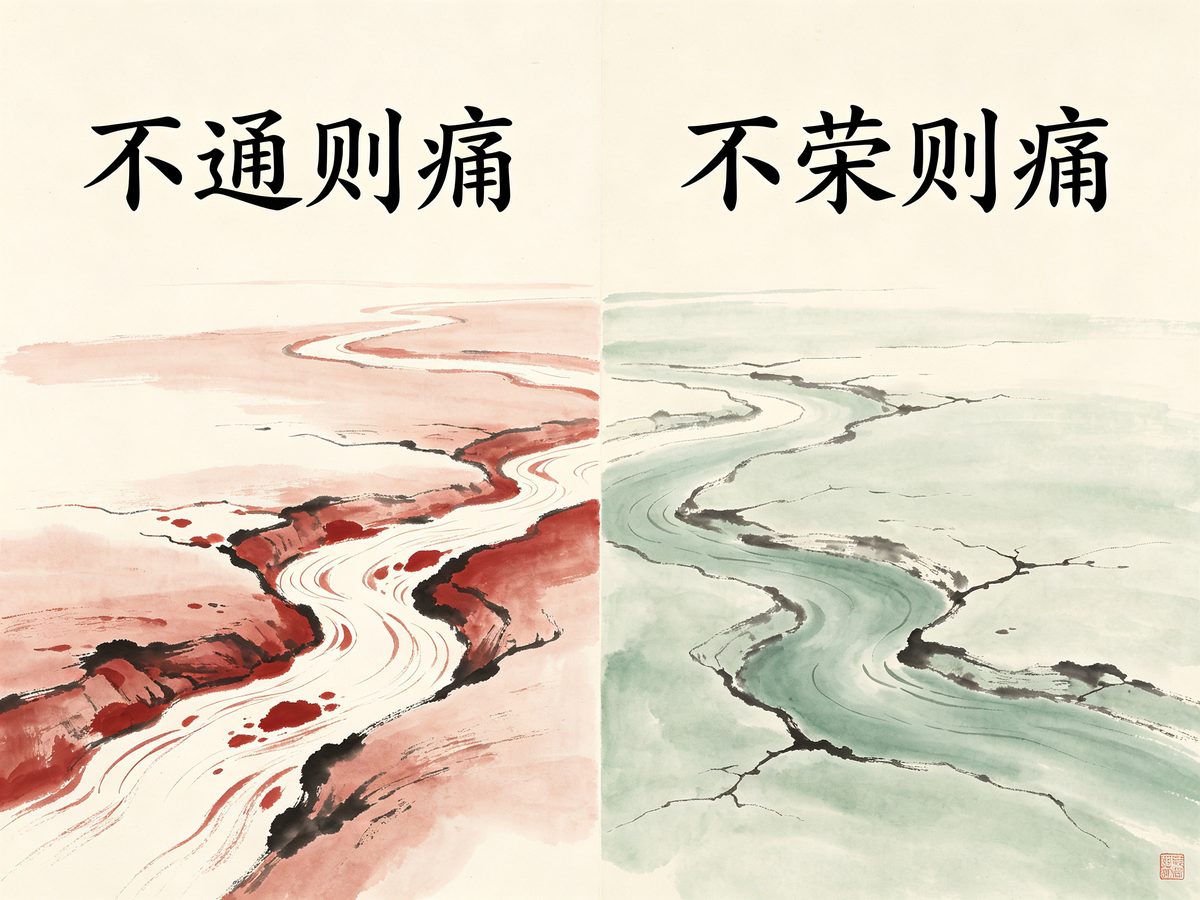
Chinese medicine explains pain with two old sayings: where there is obstruction, there is pain; where there is insufficient nourishment, there is also pain.
"Obstruction" means the qi and blood are blocked. Prolonged sitting, exposure to cold and poor posture block the flow of qi and blood at the neck, shoulders, back and legs. When it cannot move, there is pain. This kind of pain is usually distending or sharp, and it hurts more under pressure.
"Insufficient nourishment" means there is not enough qi and blood. When qi and blood are depleted and the sinews and vessels are not nourished, there is pain as well. This kind of pain is usually a dull, lingering ache that is heavier when you are tired.
One is blockage, the other is deficiency, and the treatments run in opposite directions. Get it backwards and the more you treat, the worse it becomes.
How acupuncture treats it: differently for every person
In treating the neck, shoulders, back and legs, Chinese medicine selects points according to the pattern. For someone with blockage, we take the route of "unblocking": acupuncture, moving cupping and tuina (therapeutic massage) to open the congested qi and blood. Cervical Jiaji (extraspinal points) for the neck, and Shenshu (BL23) and Dachangshu (BL25) in the lumbar region, are points we use often; the needles set the qi and blood moving again.
For someone with deficiency, we take the route of "nourishing": first tonify qi and blood and strengthen the liver and kidneys, then add gentle external treatment. The liver and kidneys govern the sinews and bones; when the liver and kidneys are deficient, the sinews and bones have nothing to hold them up, and the root has to be nourished.
So for the same back pain, two people may receive quite different needling methods and point selections. This is what Chinese medicine calls the same disease, different treatments (tong bing yi zhi).
How to protect yourself day to day
- Don't stay in one position too long. Stand and walk around after sitting a while; don't keep your head down over the phone; change posture every hour. This is the least trouble and the most effective thing of all.
- Protect the neck and lower back; don't let cold wind blow straight onto them. The cervical and lumbar regions fear cold most of all. When the weather turns cool, a scarf and something over the waist and abdomen go a long way.
- Don't just tough it out. If the pain is severe, or if there is numbness, or pain shooting into the arms and legs, don't rub it a little and leave it. See a doctor. Handled early, it is easier on you.
- Move, but don't move at random. Sensible activity nourishes the spine; random intense exercise injures it instead. If you are unsure how to move, ask first.
Neck, shoulder, back and leg pain is not a minor ailment. It is the body telling you in the most direct way it has: something here is wrong. Stop pushing the body's message away with "just being tired" — understanding it is better than pushing through it.