
Scope of Care · B
Acute lumbar sprain & stiff neck
Last updated: 2026-09-20 · Prepared by licensed TCM physicians · Updated 2026-09
Key Points
Acute lumbar sprain is an acute injury of the lumbar muscles, ligaments or fascia caused by lifting, twisting or sudden instability; stiff neck is the same kind of acute spasm in the neck. Both feature sudden severe pain, markedly limited movement and local tenderness.
- Common triggers: lifting while bent, turning to catch something, sneezing, poor sleeping position (stiff neck)
- Most are muscle-ligament level injuries that improve clearly within 1-2 weeks with proper care
- Acute-phase principle: brief rest plus progressive activity — avoid prolonged bed rest
- After trauma, any limb numbness or weakness or bowel/bladder change requires immediate medical care
First, what cannot wait
- Back or neck pain after high-energy trauma (fall from height, car accident) — manage as major trauma first, imaging mandatory
- Progressive numbness or weakness in the legs, unsteady walking
- Saddle numbness, bowel or bladder incontinence or retention — cauda equina syndrome, emergency now
- With cervical trauma: severe headache, vomiting or altered consciousness
- Severe back pain after minor force in the elderly or osteoporotic — beware compression fracture
- Persistent night pain not relieved by rest, or with fever and weight loss
- No improvement after 1 week of proper care, or worsening pain
- Recurrent sprains, several times a month — assess chronicity risk and underlying cause
Understanding the Condition
Acute lumbar sprain — "throwing out your back": in one instant a movement overloads the lumbar muscles and ligaments, producing severe pain and protective spasm that "locks" you in a bent or half-crouched posture, afraid to straighten or turn. Stiff neck is the same in the cervical spine: you wake with the neck stuck at one angle, every turn painful.
The key: "acute" does not mean "severe". Most are myofascial strains and spasm that ease significantly in 3-7 days with proper handling. But high-energy trauma — falls from height, car accidents — is an entirely different category and must be excluded first.
Why It Keeps Coming Back
The injury is instantaneous, but the "locked posture" extends it: pain triggers protective spasm, spasm deepens pain, and the less you dare move the stiffer you get. Breaking the circle — analgesia, relaxation, early activity within safe range — is the whole core of management.
Another key is distinguishing "will settle on its own" from "must be seen": pure back-buttock pain with limited motion can be managed conservatively; radiating pain, numbness, weakness or bowel/bladder changes mean nerve involvement and cannot wait.
Our Pattern-Based Approach
TCM calls it "sudden lumbar sprain with qi obstruction", an excess pattern of qi stagnation and blood stasis: the sinews are suddenly injured and qi-blood congests locally — "no flow, so pain". With wind-cold there is cold tight pain; those with underlying kidney deficiency recover slowly (deficiency root with excess branch).
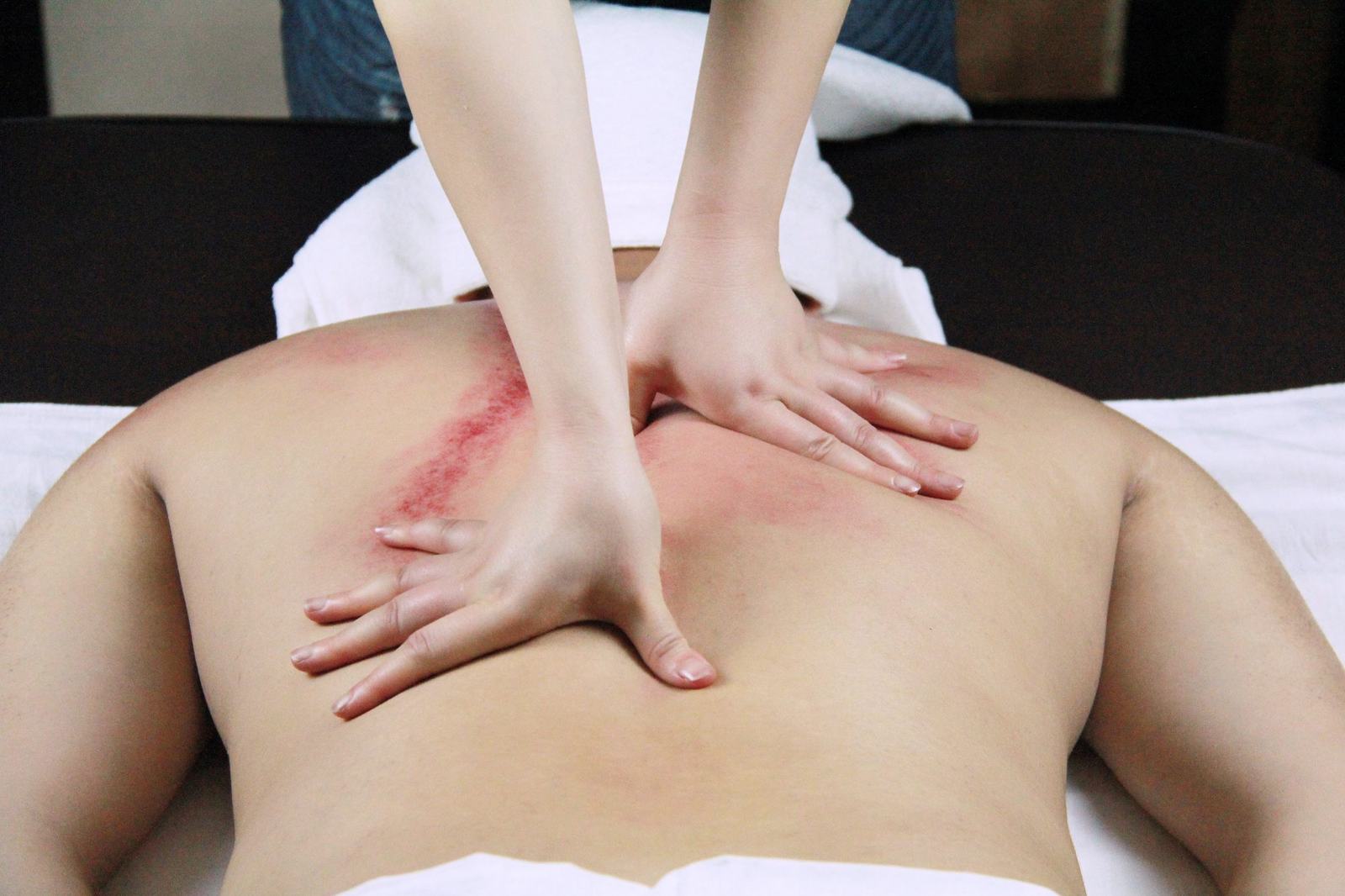
Acupuncture often relieves pain promptly: distal points Shuigou (GV26), Houxi (SI3), Yaotong extra point, Weizhong (BL40), combined with active lumbar movement (dynamic needling) quickly eases spasm; locally ashi points and lumbar jiaji with tuina and cupping. For stiff neck: Houxi (SI3), Xuanzhong (GB39), the "stiff-neck point" with neck movement techniques. We stress "treat fast, move right": once pain eases, teach correct movement immediately to prevent chronicity.
Common patterns and treatment directions
| Pattern | Typical presentation | Approach |
|---|---|---|
| Qi stagnation and blood stasis | Sudden severe fixed pain, lumbar muscles board-like, worse on turning and coughing, dark tongue | Move qi, invigorate blood: Shuigou (GV26), Houxi (SI3), Yaotong point, Weizhong (BL40); dynamic needling with tuina realignment |
| Sinew injury with cold | Cold tight pain after sprain, worse with cold, eased by warmth, local binding sensation | Invigorate blood and warm the channels: ashi points, Shenshu (BL23), Yaoyangguan (GV3), with heat packs and gentle moxibustion |
| Kidney deficiency with excess branch | Pre-existing weak low back, persistent dull pain after sprain, slow recovery, weak knees, worse with fatigue | Relieve pain and tonify kidney: Weizhong (BL40), ashi points plus Shenshu (BL23), Taixi (KI3); gentle technique, treat both root and branch |
| Damp-heat congestion | Lumbar pain with burning sensation, bitter taste, dark scanty urine, local tense heat on pressure | Clear heat, drain dampness: Dachangshu (BL25), Yinlingquan (SP9), Weizhong (BL40); moxibustion avoided, cold packs for analgesia |
| Vessel injury with blood extravasation | Marked swelling with visible bruising, refuses pressure, severe movement restriction | Reduce swelling and stop pain: cold packs and relative rest in the acute stage; after 48 hours, acupuncture at ashi and Huantiao (GB30) with very gentle technique |
Patterns are determined in person. This list is for orientation only and is not a self-diagnosis tool.
The Evidence
- Evidence for acupuncture in acute back pain is inconsistent, with limited high-quality trials; our acute-phase management follows clinical standards, using acupuncture as an analgesic and antispasmodic measure as needed.
—
What to expect: first visit to follow-up
- Visit · as early as possible (same day to 48 hours)We take a history (the injuring movement, pain location), examine (tenderness, range, neurological screening) and first exclude fractures and nerve injuries needing referral — in the acute phase this always comes first.
- Acute-phase care · same dayWe spell out what you can and cannot do: how long to rest, ice or heat, which movements are banned for now. Distal-point acupuncture for analgesia and antispasm can be done the same day — most feel immediate loosening.
- Days 2-7Pain and spasm gradually ease: tuina realignment and cupping join in, activity expands within safe range. Targets: standing upright, walking, light housework.
- Weeks 1-2 · closing and preventionOnce pain has largely settled, a systematic review of strength and movement patterns, a recovery program (cat-camel, glute bridge, Ba Duan Jin), and an analysis of why this sprain happened — preventing recurrence matters more than treating pain.
Course of care and follow-up
- Simple sprains usually improve markedly within 1-2 weeks; one review at the end of week 1
- If clear pain persists at 2 weeks, re-assess for nerve involvement or structural problems
- Recovery training is advised for 4-6 weeks to consolidate lumbar stability
- Recurrent sprains call for a full evaluation (core strength, work posture, lifting habits) and consideration of underlying disc or facet problems
When to Seek Care
Before your visit:
- Avoid provoking movements for the first 1-2 days, but do not bed-rest absolutely; walk if you can walk
- Ice or heat: brief ice in the first 48 hours, then warm packs to relax the muscle
- Sleep on a firm mattress with a thin topper; side-lying with bent knees spares the back
- Start gentle range-of-motion drills as pain subsides to prevent stiffening
Consider an in-person consultation if:
- Pain so severe you cannot stand or walk, or no relief after 3-5 days
- Pain radiating to buttock or leg, or with numbness — nerve involvement needs assessment
- Older adults or those with osteoporosis with severe pain after a minor movement — beware vertebral compression fracture
- After trauma, any limb numbness, weakness or bowel/bladder change — seek care immediately
Supportive Care
- First 48 hours: avoid twisting and bending again; rise by rolling sideways and pushing up with hands
- Warm packs: 2-3 times daily for 15-20 minutes with slow flexion-extension drills
- Recovery training: cat-camel and glute bridges once pain subsides, rebuilding lumbar stability
- Resume Ba Duan Jin in the recovery phase, progressing gently through the forward-bend movements
FAQ
Can I get massage and bone-setting right after the injury?
It depends. For pure muscle spasm, gentle release helps; but before swelling is controlled and fracture or ligament injury excluded, no forceful manipulation. "Diagnose the injury first, then treat" is the rule — after trauma, imaging always precedes hands-on therapy.
I woke with a stiff neck — can someone crack it for me?
Not advisable. Stiff neck is muscle spasm with joint derangement; forceful twisting can worsen it, even injure the cervical spine. The right approach: warm packs, slow movement into tolerable range, acupuncture for pain and spasm — most ease clearly within 1-3 days.
Want your situation assessed? Book a consultation.
Prepared by licensed TCM physicians · Updated 2026-09