
Scope of Care · A
Knee osteoarthritis
Last updated: 2026-09-20 · Prepared by licensed TCM physicians · Updated 2026-09
Key Points
Knee osteoarthritis is a chronic joint disease marked by cartilage degeneration and marginal osteophyte formation 鈥 knee pain, morning stiffness (usually under 30 minutes), and difficulty with stairs, squatting and standing up.
- The most common joint disease; over half of people over 60 show radiographic changes
- Risk factors: age, obesity, prior knee injury, prolonged squatting or kneeling
- Acupuncture for knee osteoarthritis is well evidenced, especially combined with quadriceps training
- The goal is not "replacing the knee" but controlling pain, maintaining function, and delaying or avoiding surgery
First, what cannot wait
- One knee red, swollen, hot and intensely painful with fever 鈥 suspect septic arthritis or acute gout; do not rely on external therapies alone, seek care immediately
- Marked swelling, inability to bear weight or locking after trauma 鈥 suspect ligament/meniscus injury or fracture
- Calf swelling, pain and tenderness 鈥 suspect deep vein thrombosis
- Night rest pain steadily worsening, unresponsive to analgesics
- Recurrent large effusions
- Clearly progressing deformity or declining walking ability
Understanding the Condition
Knee osteoarthritis is not simply "worn out". Cartilage wear does track with age, but symptom severity depends more on the strength of surrounding muscles, joint stability and inflammation. The same X-ray can belong to someone walking freely and someone barely moving 鈥 the difference lies in soft tissue.
In plain words: bone is the "foundation", muscle is the "knee brace". The foundation's wear is hard to reverse, but the brace can be strengthened 鈥 that is the shared pivot of all conservative care.
Why It Keeps Coming Back
Obesity, years of squatting work and old injuries overload the knee; then pain reduces activity, the quadriceps waste, stability drops and load concentrates further 鈥 another "the more it hurts, the less you move; the less you move, the more it hurts" cycle.
Long-term painkiller reliance only masks pain without changing structural progression, and carries gastric and renal risks. Guidelines agree: exercise therapy and weight loss are the foundation; medication and intra-articular treatments are added as needed.
Our Pattern-Based Approach
TCM calls knee osteoarthritis "knee bi (obstruction)", linked to "wind, cold and dampness combined" and to liver-kidney deficiency. Common patterns: wind-cold-damp bi 鈥 cold aching pain worse with cold; blood stasis 鈥 fixed pain, chronic; liver-kidney deficiency 鈥 weak knees, trouble with stairs, sore lower back; qi-blood deficiency 鈥 worse with fatigue, pale complexion.
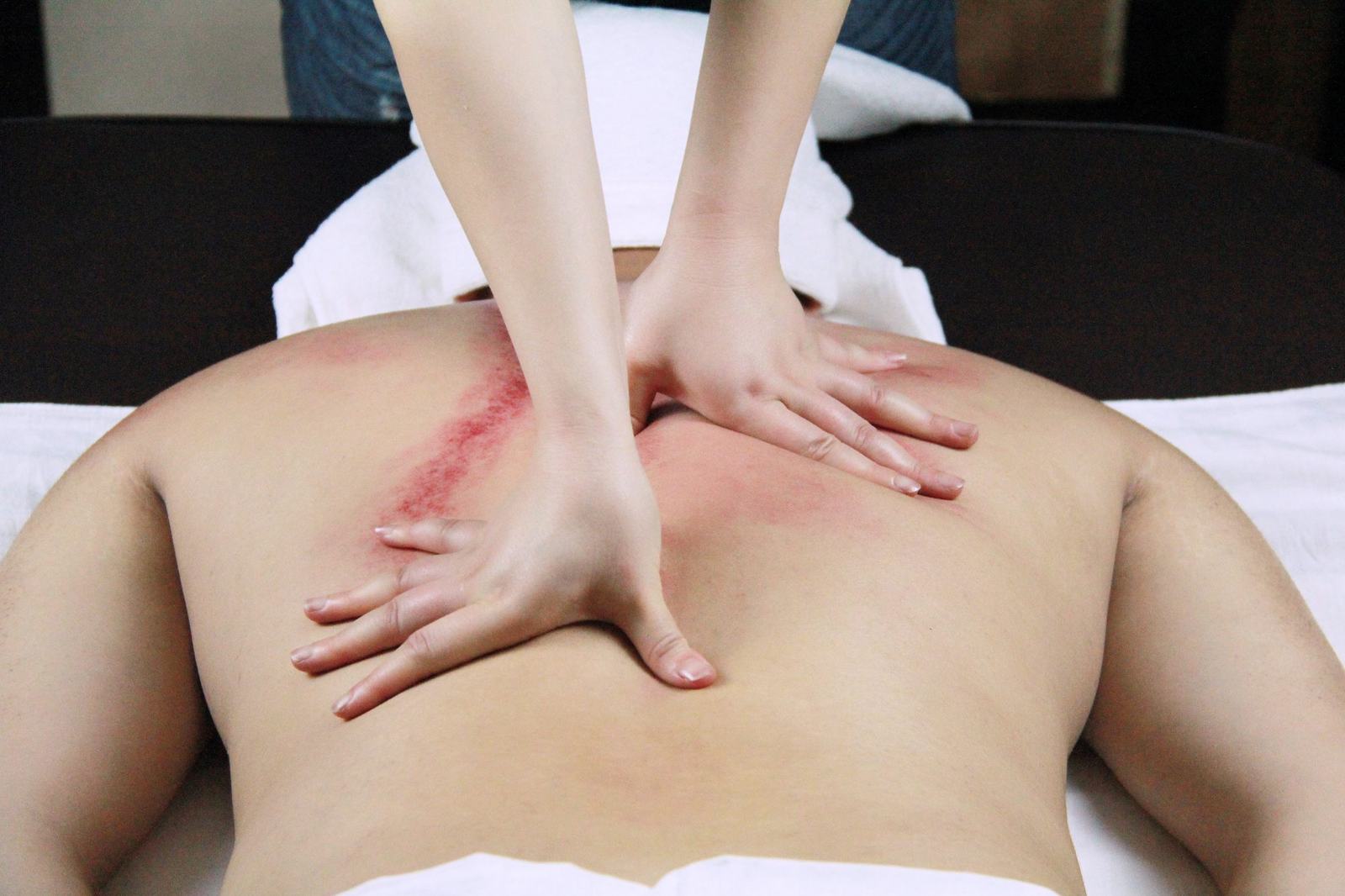
Acupuncture uses Neixiyan, Dubi (ST35), Yanglingquan (GB34), Xuehai (SP10), Liangqiu (ST34) and Zusanli (ST36), with warm needling, moxibustion and periaricular tuina. We equally stress quadriceps isometrics and Ba Duan Jin 鈥 "the sinews bind the bone"; strong sinews steady the joint.
Common patterns and treatment directions
| Pattern | Typical presentation | Approach |
|---|---|---|
| Wind-cold-damp bi | Cold aching knee, worse with cold, eased by warmth, worse in damp weather, limited motion | Dispel wind-cold-damp, warm the channels: Neixiyan, Dubi (ST35), Yanglingquan (GB34), with warm needling and moxibustion |
| Blood stasis obstruction | Fixed stabbing pain refusing pressure, possible injury history, stiff flexion-extension, dark tongue with stasis spots | Invigorate blood: Xuehai (SP10), Liangqiu (ST34), Geshu (BL17), ashi points, with collateral pricking and tuina |
| Liver-kidney deficiency | Weak knees, stairs difficult, worse after long standing or walking, sore lower back, tinnitus | Tonify liver and kidney: Zusanli (ST36), Taixi (KI3), Xuanzhong (GB39), Shenshu (BL23); gentle reinforcing needling plus long-term exercise |
| Qi and blood deficiency | Dull knee pain worse with fatigue, pale complexion, low energy, no marked redness or swelling | Tonify qi and blood: Zusanli (ST36), Sanyinjiao (SP6), Qihai (CV6); gentle needling plus dietary support |
| Phlegm and stasis interacting | Long-standing disease, enlarged deformed joint, heavy stiffness, crepitus on motion | Transform phlegm, invigorate collaterals: Fenglong (ST40), Yinlingquan (SP9), Xuehai (SP10), periaricular ashi points, with warm needling and exercise |
Patterns are determined in person. This list is for orientation only and is not a self-diagnosis tool.
The Evidence
- An individual-patient-data meta-analysis of ~18,000 participants found acupuncture significantly superior to sham acupuncture and usual care for chronic pain, including knee osteoarthritis.
— Vickers et al., 2012, Archives of Internal Medicine (now JAMA Internal Medicine) - The German three-armed GERAC randomized trial in knee osteoarthritis found better pain and function outcomes with verum than with sham acupuncture.
— Scharf et al., 2006, Archives of Internal Medicine
What to expect: first visit to follow-up
- First visit 路 about 40 minutesBring your X-ray/MRI report and a description of current activity. We take a history, examine the knee (tenderness, range, patellar tap, stability), read pulse and tongue, grade severity and screen red flags 鈥 confirming whether conservative care fits your situation.
- Plan discussion 路 same dayWe explain the pattern diagnosis, planned points and frequency, and assign homework: how and how often to do leg-setting and straight-leg raises, plus weight and activity targets.
- Weeks 1-4One to two sessions weekly (warm needling or moxibustion by pattern). Targets in order: lower rest and activity pain, easier stairs. You keep training the quadriceps and log pain scores.
- Weeks 4-8 路 review and maintenanceYour scores decide the next step: continue, adjust points, or move to maintenance every 2-4 weeks, handing the focus to exercise and weight management.
Course of care and follow-up
- Assessment usually runs in 4-8 week cycles
- Once stable, maintenance every 2-4 weeks
- Symptoms and function (walking distance, stairs, squat-to-stand) re-reviewed yearly
- If proper conservative care fails beyond 3 months with severely impaired quality of life, we assist referral to orthopedics for surgical indication 鈥 never delaying necessary surgery
When to Seek Care
Before your visit:
- Manage weight 鈥 every kilogram lost meaningfully reduces knee load
- Avoid prolonged squatting, kneeling, stair climbing and loaded deep squats
- Keep low-impact activity when pain allows: flat-ground walking, swimming, cycling
Consider an in-person consultation if:
- Knee pain lasting weeks, with morning stiffness or marked stair difficulty
- Recurrent joint swelling, giving way, or locking (sudden catching)
- Red, hot, swollen joint or night rest pain 鈥 seek care promptly to exclude other disease
Supportive Care
- Exercise: quadriceps isometrics (leg setting) and straight-leg raises, 2-3 sets daily
- Ba Duan Jin / Tai Chi: slow movements without deep squats, improving flexibility and balance
- Warmth: knee sleeve in cold seasons and air-conditioned spaces
- Gait and footwear: cushioned supportive shoes; limit long walks on hard surfaces
FAQ
Can acupuncture replace knee replacement?
No 鈥 and there is no need to frame it as either-or. When moderate-to-severe osteoarthritis fails proper conservative care and quality of life collapses, surgical assessment is a reasonable choice. Our aim is: in the phase where surgery is not yet needed, lower pain, restore function, reduce painkiller dependence 鈥 and preserve your options.
Should joint effusion be drained, and repeatedly?
Small effusions usually resorb with conservative care; a large, tense effusion can be aspirated for quick relief 鈥 but the key is finding why fluid collects (degeneration, synovitis, gout, infection). Recurrent effusion calls for cause work-up, not repeated taps.
Want your situation assessed? Book a consultation.
Prepared by licensed TCM physicians · Updated 2026-09
Related case note Knees that dread surgery: first sort out walking, stairs, and squatting Read the case note →