
Scope of Care · A
Cervical spondylosis & neck pain
Last updated: 2026-09-20 · Prepared by licensed TCM physicians · Updated 2026-09
Key Points
Cervical spondylosis is a group of disorders caused by degenerative changes of the cervical discs and joints compressing or irritating nerves, blood vessels or the spinal cord 鈥 typically neck pain and stiffness, sometimes with arm numbness or dizziness.
- Common in desk workers and smartphone users, increasingly at younger ages
- Classified into axial (muscular), radicular, vertebral-artery and myelopathic types 鈥 management differs substantially
- Most types respond well to conservative care; acupuncture is among the best-evidenced approaches for chronic pain
- Cord compression signs (unsteady gait, clumsy hands) need prompt orthopedic assessment
First, what cannot wait
- Progressive numbness or weakness in the arms and legs, or unsteady walking with a "walking on cotton" sensation 鈥 possible spinal cord compression; seek orthopedic/neurosurgical assessment urgently
- Neck pain after trauma with limb numbness or limited movement 鈥 rule out fracture first; no massage or manipulation
- Bowel or bladder dysfunction, or numbness in the saddle (perineal) region
- Neck pain with high fever, severe headache or altered consciousness
- One-sided arm numbness with visible muscle wasting or markedly weaker grip
- Recurrent dizziness or visual blackouts clearly triggered by head rotation
- Night pain that wakes you, with painkillers working less and less
Understanding the Condition
Cervical spondylosis is not "a sore neck" 鈥 it is a syndrome in which degenerated cervical structures compress or irritate surrounding tissue. The most common forms are axial neck pain (muscle and ligament soreness and stiffness) and cervical radiculopathy (a disc or bone spur pressing a nerve root, sending pain down the arm with tingling fingers).
In plain words: simple neck-shoulder ache is "muscles on strike"; once numbness, radiating pain or unsteady walking appears, a "wire is being pinched" 鈥 the two situations differ in severity and in what should be done.
Why It Keeps Coming Back
Because the causes are cumulative: prolonged forward head posture, desk work, poor pillow support and cold exposure reshape the cervical curve and muscle tension day after day. Massage only when it hurts does not stop the process.
Many people fixate on "bone spurs", but symptoms are driven mainly by muscle condition, postural load and local circulation. That is why exercise therapy matters as much as treatment 鈥 imaging degeneration and symptoms often do not match.
Our Pattern-Based Approach
TCM calls this "neck bi (obstruction)" and reads the qi-blood state of the neck-shoulder region rather than the vertebrae alone. Common patterns: wind-cold obstruction 鈥 worse after cold exposure, tight and cold; qi stagnation and blood stasis 鈥 fixed stabbing pain from chronic strain; liver-kidney deficiency 鈥 years of aching weakness with tinnitus and sore lower back.
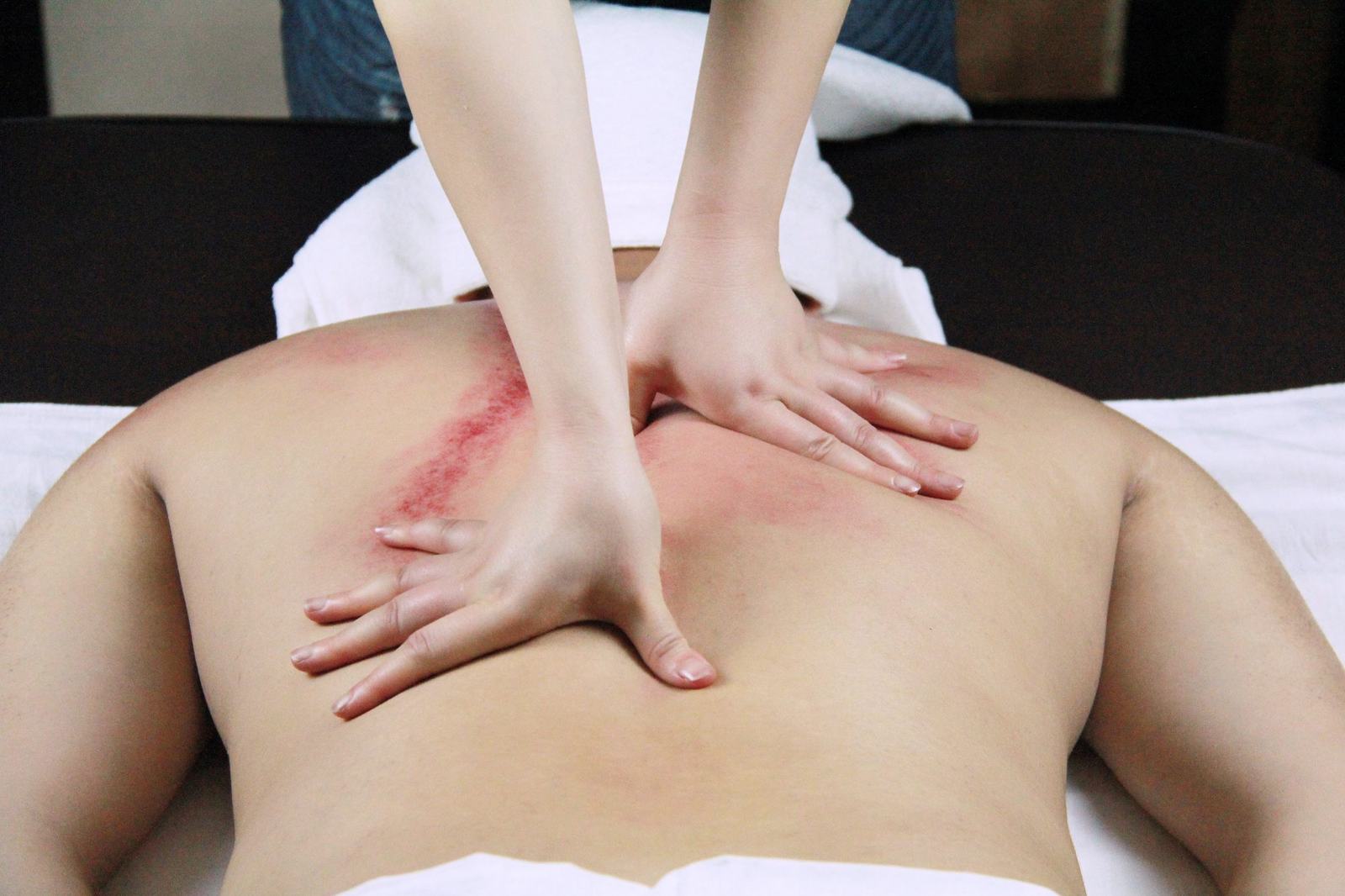
Acupuncture uses cervical huatuo-jiaji points, Fengchi (GB20), Tianzhu (BL10), Houxi (SI3); tuina releases the strained trapezius and levator scapulae; cupping and moxibustion warm the channels. Our approach runs in three steps: release, adjust, then train 鈥 first relax the muscles, restore alignment, then teach you the exercises that maintain it.
Common patterns and treatment directions
| Pattern | Typical presentation | Approach |
|---|---|---|
| Wind-cold obstruction | Cold, tight neck-shoulder pain, worse with cold exposure, eased by warmth, limited neck motion | Dispel wind-cold, warm the channels: Fengchi (GB20), Tianzhu (BL10), Dazhui (GV14), with moxibustion and cupping |
| Qi stagnation and blood stasis | Fixed stabbing pain, worse at night, history of chronic strain, dark tongue with stasis spots | Move qi and blood: cervical jiaji points, Houxi (SI3), Geshu (BL17), with tuina release of strained muscles |
| Liver-kidney deficiency | Years of aching weakness, sore knees and lower back, tinnitus, blurred vision | Tonify liver and kidney: Ganshu (BL18), Shenshu (BL23), Taixi (KI3), Xuanzhong (GB39); gentle technique plus long-term exercise |
| Phlegm-dampness obstructing the channels | Heavy, aching neck-shoulders, dull heavy head, often with excess weight, worse in damp weather | Transform phlegm and drain dampness: Fenglong (ST40), Yinlingquan (SP9), Fengchi (GB20), with diet and weight guidance |
| Qi and blood deficiency | Dull lingering ache, worse with fatigue, pale complexion, intermittent hand numbness | Tonify qi and blood: Zusanli (ST36), Sanyinjiao (SP6), cervical jiaji; gentle needling, few points |
Patterns are determined in person. This list is for orientation only and is not a self-diagnosis tool.
The Evidence
- An individual-patient-data meta-analysis of ~18,000 participants found acupuncture significantly superior to sham acupuncture and usual care for chronic pain, including neck pain.
— Vickers et al., 2012, Archives of Internal Medicine (now JAMA Internal Medicine) - A Cochrane systematic review found acupuncture provides short-term pain relief for chronic neck disorders, superior to some sham controls.
— Cochrane Database of Systematic Reviews, Acupuncture for neck disorders, 2006
What to expect: first visit to follow-up
- First visit 路 about 40 minutesBring your imaging and a description of your workstation. We take a full history, palpate muscle tension and cervical range, run nerve-provocation tests, and read pulse and tongue. Axial and radicular types follow different paths; if myelopathy or red flags are suspected, we advise imaging and specialist review first.
- Plan discussion 路 same dayWe explain the pattern diagnosis, planned points and techniques, treatment frequency, and what you must do yourself: workstation changes, pillow, a few minutes of daily neck exercise.
- Weeks 1-4One to two acupuncture and tuina sessions per week. Targets in order: lower pain, better range of motion, fewer night symptoms. You log when and why numbness occurs at home.
- Weeks 4-8 路 review and maintenanceYour logs before and after treatment decide the next step: continue, adjust point selection, or move to longer-interval maintenance with exercise as the focus.
Course of care and follow-up
- Assessment usually runs in 4-8 week cycles
- Once stable, maintenance every 2-4 weeks with the focus shifting to your home exercise program
- Pattern and imaging are re-reviewed yearly or when symptoms change
- Where imaging shows cord or severe nerve-root involvement, we work alongside orthopedics/neurosurgery and never replace a necessary surgical evaluation
When to Seek Care
Before your visit:
- Raise your screen so its top edge is at eye level; hold the phone up, not down
- Stand and move your neck and shoulders every 40-50 minutes of desk work; practice slow chin tucks
- Choose a pillow that supports the cervical curve; avoid cold drafts on the neck
Consider an in-person consultation if:
- Pain radiating into the arm with finger numbness, or waking at night from tingling
- Neck pain not easing after 2-4 weeks, or repeatedly disrupting work
- Dizziness clearly triggered by head turning, or clumsiness of the hands 鈥 seek assessment promptly
Supportive Care
- Exercise: daily cervical flexion-extension and chin-tuck drills, plus Ba Duan Jin stretching
- Sleep: supine position with a pillow supporting the neck curve, not the head only
- Warmth: scarf in cold seasons; avoid direct cold wind after sweating
- Stress: the neck is the "thermometer" of tension 鈥 pair care with breathing relaxation if you are chronically stressed
FAQ
Is neck manipulation with an audible "crack" safe?
Proper tuina focuses on muscle release and gentle repositioning; cervical rotation techniques have strict indications and contraindications. For older patients, vertebral-artery insufficiency or signs of cord compression we avoid forceful rotation 鈥 safety comes before any "click".
My X-ray shows bone spurs 鈥 do they need treating?
No. Spurs are a common degenerative finding; many people have them without symptoms. The treatment goal is lower pain, better neck mobility and muscle function, fewer flare-ups 鈥 not erasing spurs from an image.
Want your situation assessed? Book a consultation.
Prepared by licensed TCM physicians · Updated 2026-09
Related case note Stiff neck, numb hands: managing the desk worker's cervical spine Read the case note →